


If you have been crocheting for a while, you have probably come across the name Ravelry. A designer may tell you that a pattern is available on Ravelry, you may find a link to someone’s Ravelry project while researching a pattern, or another crocheter may recommend searching Ravelry when you are looking for ideas.
But what exactly is Ravelry?
Ravelry is a free online platform for knitters, crocheters and other fiber artists. It combines an extensive database of patterns and yarns with personal tools for organising your crochet projects and materials, as well as community features such as groups and forums.
Rather than being simply a website where you can buy patterns, Ravelry can be thought of as a large, interconnected database for the fiber arts. Patterns are connected with designers, yarns, publications and thousands of projects made by other users. At the same time, your own Ravelry account can function as a personal record of what you have made, what yarn you own, which patterns you have collected and what you might want to make next.
According to Ravelry, the platform has three main areas: the Database, your personal Notebook and the Community.
About Ravelry
How did Ravelry start?
The idea behind Ravelry came from a very practical problem.
Ravelry founder Jessica had been knitting and blogging and found it difficult to find organised information about patterns and yarns online. For example, she might want to find a pattern suitable for a particular yarn already in her stash, or find an alternative yarn for a cardigan she wanted to make.
The information existed, but it was scattered across blogs and different websites.
In Ravelry’s original April 2007 introduction to the site, Jessica explained that she wanted a way to bring this information together and make it searchable and useful to other fiber artists.
Cassidy, Ravelry’s co-founder and developer, began writing the code for the site in October 2006. Ravelry was being tested by its first users in early 2007, and one of the earliest Ravelry blog posts describing the project was published on 10 April 2007.
The basic idea was already remarkably similar to the Ravelry we know today: a place where knitters and crocheters could record their projects, yarn and pattern information while also learning from the information contributed by other users.
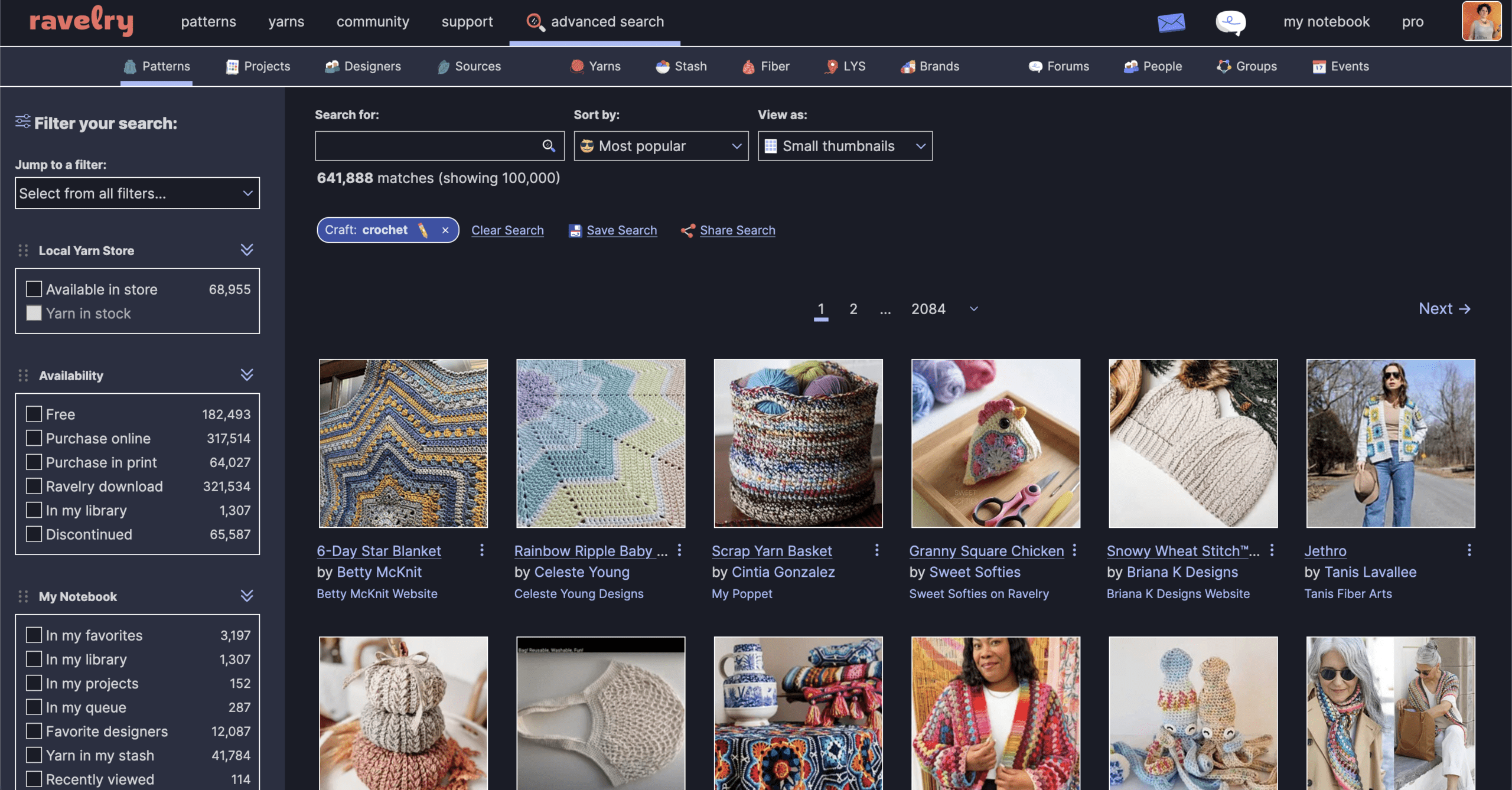
Ravelry is a database – not just a pattern shop
This is perhaps the most important thing to understand when you first use Ravelry.
A Ravelry pattern page does not necessarily mean that the pattern itself is available through Ravelry.
The pattern database catalogues patterns from many different sources. A pattern might be available as a downloadable PDF through Ravelry, but it might instead be published on a designer’s website, in a magazine, in a book or through another source.
Ravelry therefore serves partly as a catalogue.
If a pattern is available as a Ravelry download, its pattern page will provide the corresponding option to purchase it or, in the case of a free Ravelry download, access the free pattern. For other patterns, the pattern page can instead tell you where the pattern was published or where it may be available.
This distinction is useful because it allows the database to contain information about far more than the patterns sold directly through the platform.
Searching for crochet patterns
One of Ravelry’s most powerful features is its pattern search.
You can perform a simple search if you already know what you are looking for, but Ravelry also offers an Advanced Search that allows you to narrow the results using many different criteria.
That means you don’t necessarily need to start with the name of a pattern.
You could instead be looking for a crochet cardigan, for example, and progressively narrow the results according to the characteristics that matter to you. The extensive information attached to patterns is what makes Ravelry particularly useful as a research tool rather than simply as a catalogue of pattern names.
Ravelry describes its pattern and yarn database as being built by its users, with volunteer editors also helping to keep information organised and up to date.
We will look at the pattern search and its filters in detail in the next article in this series.
Learn from other people’s projects
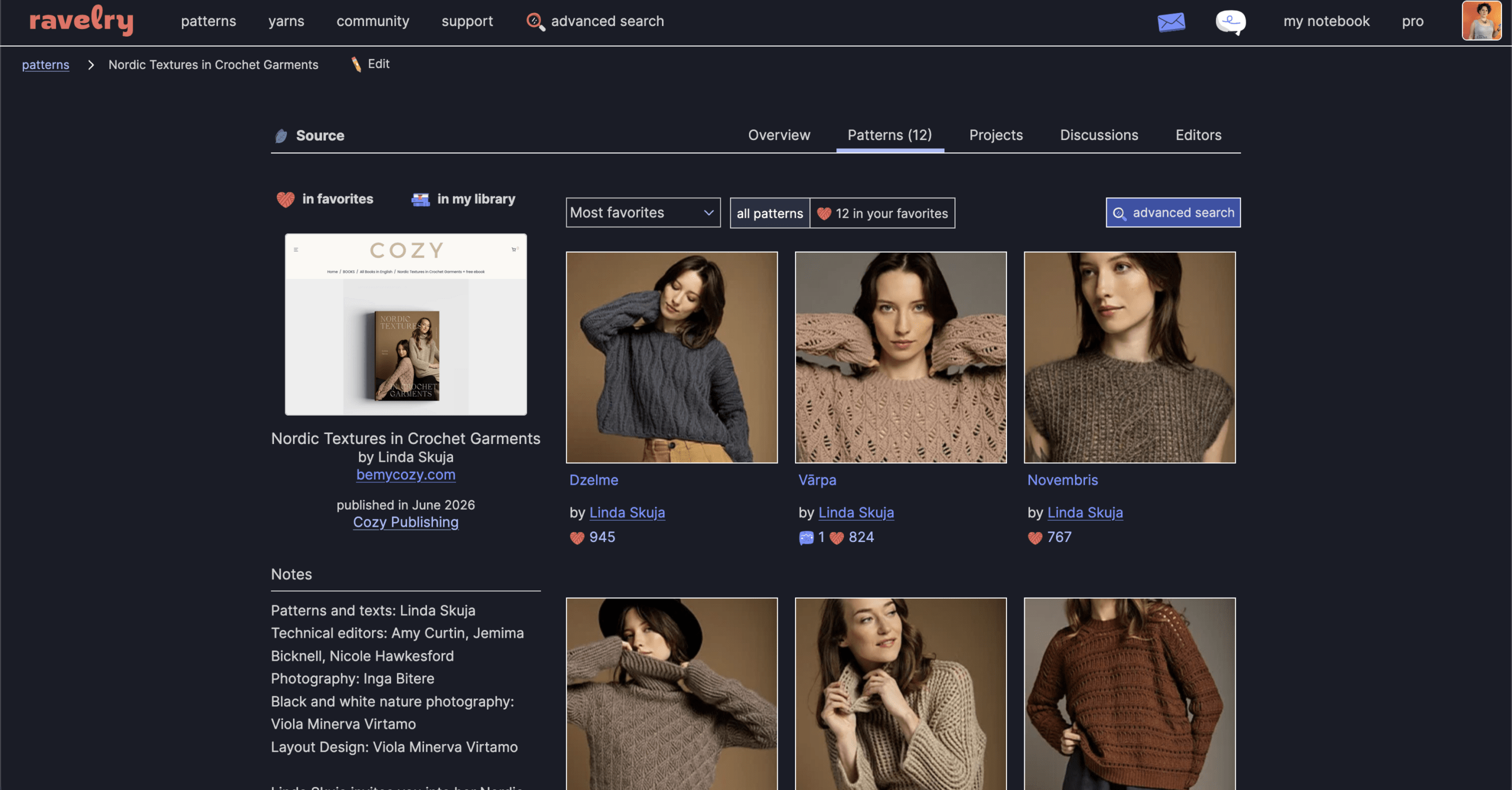
Another particularly useful feature is the connection between a pattern and the projects that people have made from it.
Ravelry users can create Project entries in their personal Notebook. A project can be connected to the pattern and yarn used, and the maker can add information and photographs of the finished or ongoing project.
As a result, when researching a pattern you can often look beyond the designer’s original sample and see how other crocheters have made it.
Depending on what users have recorded, project pages can provide useful information about yarn choices, modifications and the maker’s experience with a project. Ravelry also allows you to browse the projects associated with a pattern and filter them by different attributes.
This is one of the reasons Ravelry becomes increasingly useful as people contribute information: an individual project record can also help someone else who is researching the same pattern.
Your Ravelry Notebook
Ravelry isn’t only about finding information created by other people. You can also use it to organise your own crochet life.
Your personal Notebook contains several sections for keeping track of different kinds of information.
For example, Projects can record what you are making or have already made, while Stash can be used to keep track of yarn you own.
Your Queue is designed for projects you would like to make in the future. Queue entries can include information such as the pattern, yarn you intend to use, who you plan to make the project for, a desired completion date and organisational tags.
Favorites allow you to save things you find interesting or inspiring, while your Library helps you keep track of patterns and publications you own or have access to.
There are additional Notebook features as well, including sections for tools and handspun yarn.
These functions can be used independently, but their real strength comes from connecting information together. A yarn in your stash can, for example, be linked with a future project in your Queue and later with the actual Project when you start making it.
The Ravelry community
Ravelry is also a social platform.
Its community includes groups and forums covering fiber crafts, designers, techniques, local communities, craft-alongs and many other interests. Users can add other Ravelers as friends and follow what they are making.
This community aspect was part of Ravelry from its earliest days. In its original 2007 introduction, Ravelry described itself as a place where people could share projects, participate in craft-alongs, socialise with other crafters and contribute information that could be useful to someone working on a project elsewhere in the world.
Today, Ravelry describes its community as consisting of millions of yarn lovers around the world and thousands of forums and groups.
Is Ravelry free?
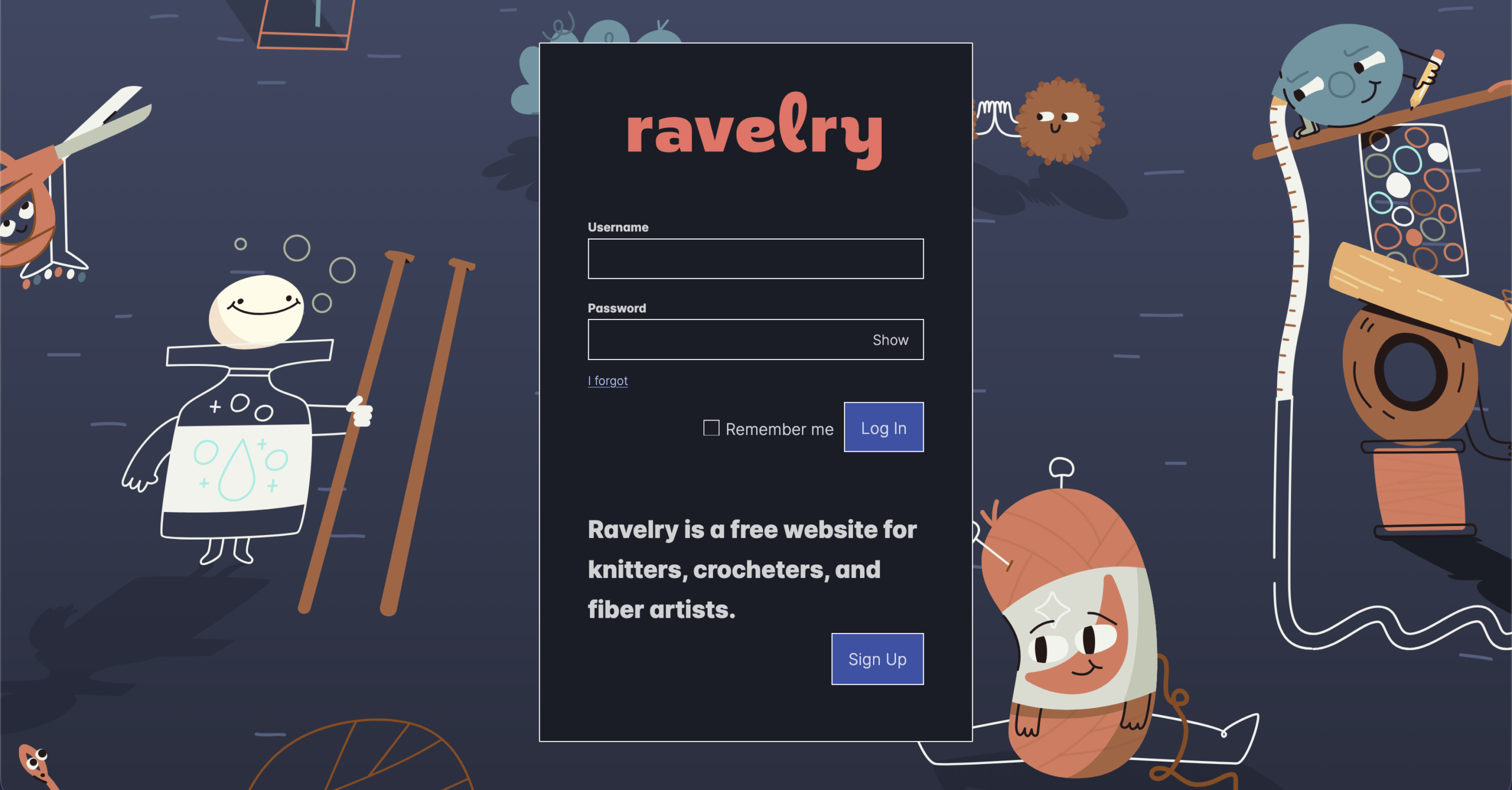
Creating and using a Ravelry account is free.
This was an explicit goal from the beginning. In the original 2007 Ravelry FAQ, Jessica wrote that the site would remain free for designers, independent dyers, spinners, crocheters and knitters, with advertising helping to support the platform.
Ravelry’s current sign-up page continues to describe it as a free website for knitters, crocheters and fiber artists.
Individual patterns sold through Ravelry can, of course, be paid products. The fact that Ravelry itself is free does not mean that every pattern listed in its database is free.
Why is Ravelry useful for crocheters?
You can use Ravelry very simply – for example, only visiting it when you need to purchase a particular pattern. But much of its value comes from using the connections between its different types of information.
You might discover a pattern through a search, look through projects made by other crocheters, investigate which yarns they used, save the pattern for later, link it with yarn already in your stash and eventually create your own project entry when you start crocheting.
Or you can approach the process from the opposite direction: start with a yarn you already own and use Ravelry to research what other people have made with it.
The amount of information available can make Ravelry look complicated when you first encounter it. You certainly don’t need to learn every feature at once.
Over the next articles in this series, we will look at the different functions individually and explain how you can use them for your own crochet projects – beginning with one of Ravelry’s most useful tools: how to search for a crochet pattern.